Most developers understand radiation surveys as a checkbox: commission one, file it, move on. That assumption is costing projects millions of shekels and months of delay every year.
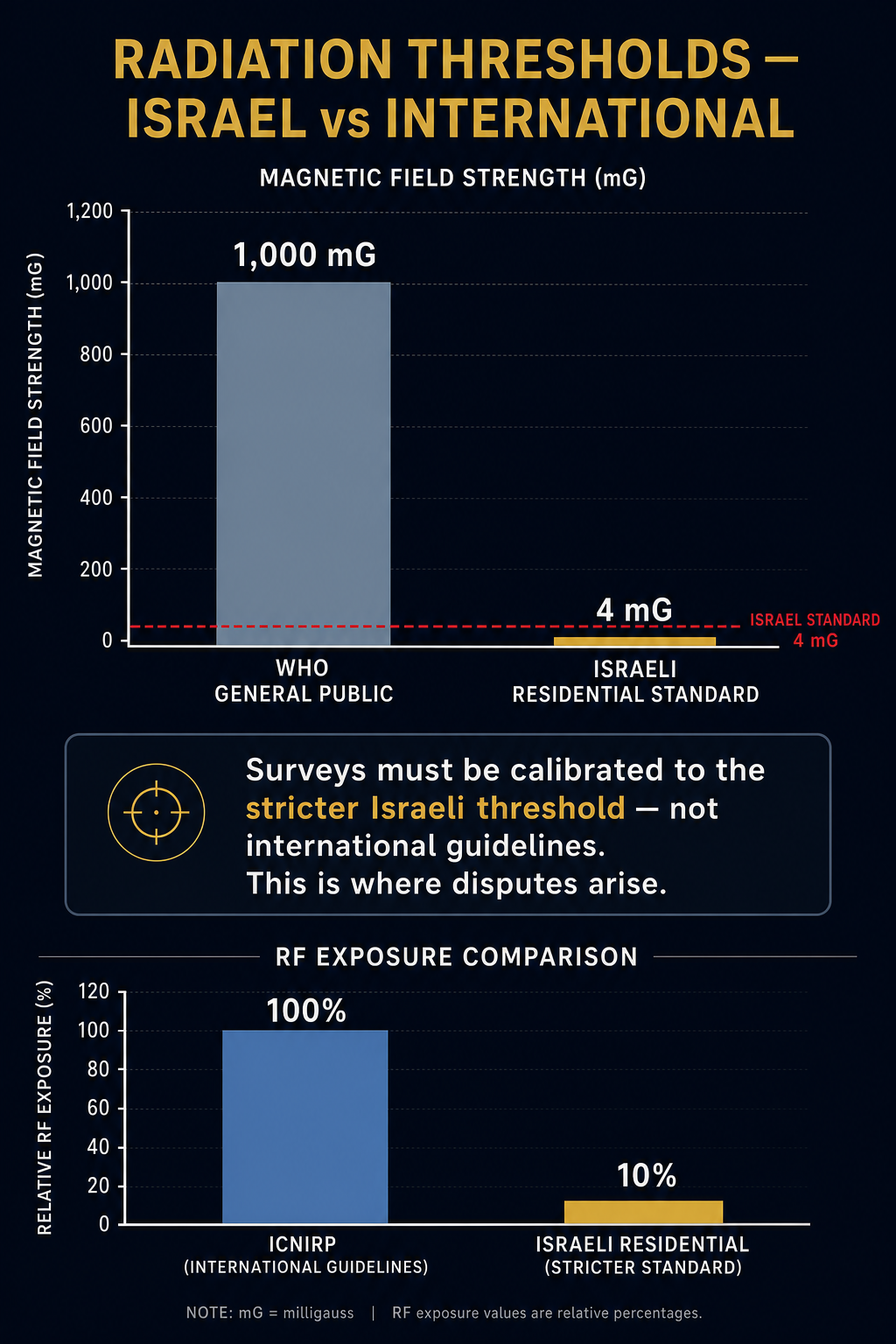
Israel's radiation thresholds are among the strictest in the world — set independently of WHO guidelines, calibrated to residential exposure rather than general public norms. A survey produced without deep familiarity with these standards will be rejected, revised under committee pressure, or accepted with conditions that cost more than a first-rate specialist would have charged to begin with.
- Consultant uses WHO or ICNIRP thresholds — not the stricter Israeli MoEP standard (4 mG ELF / 10% ICNIRP RF)
- Survey produced without dual MoEP service licence — rejected on procedural grounds before content is reviewed
- No expert-witness-grade documentation — authority requests revision, project stalls
- Conservative radius assumptions left unchallenged — thousands of square meters of buildable area surrendered unnecessarily
Dr. Liran Raz Steinkritser has spent 25 years ensuring that version of the story doesn't happen to his clients. As the senior radiation and environmental engineering specialist at Razore Engineering, he holds dual Ministry of Environmental Protection service licences — for both ELF and RF non-ionizing radiation — a PhD from the University of Haifa, and two decades of recognition as a qualified expert witness by Israeli courts and the Ministry of Defense. The surveys his office produces are not rejected by committees. They are not revised under pressure. They are built to withstand challenge from the first submission.
Three Projects That Show What's Possible
These are not illustrative scenarios. Each represents an actual engagement where Dr. Raz Steinkritser's methodology translated directly into financial impact — cases that Razore Engineering has documented.
A developer's attorney brought in Razore after a planning committee issued a ₪3 million green building compliance demand — an amount that rendered the project economically unviable. The demand was not wrong in principle; it was based on conservative assumptions that Razore's analysis showed were not supported by the actual building parameters. A detailed compliance assessment, structured regulatory argument, and revised documentation reduced the required scope by 40%, cutting the cost to ₪1.8M and allowing the project to proceed.
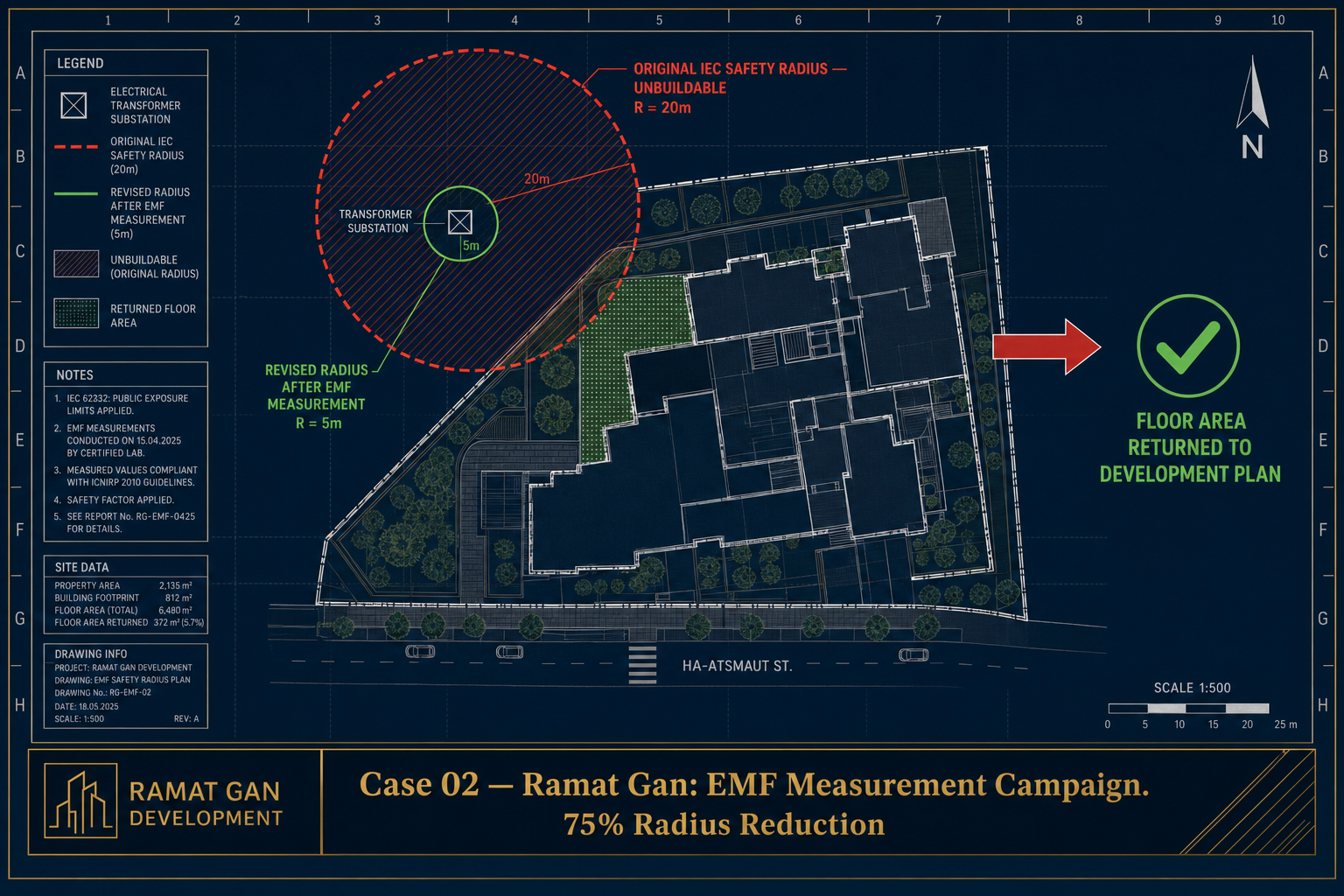
Israel Electric Company had prescribed a 20-meter safety radius from a transformer installation on the development site — effectively removing a significant portion of the buildable floor area from the project. Dr. Raz Steinkritser conducted a comprehensive EMF field measurement campaign, analyzed actual exposure levels against Israeli thresholds, and submitted a peer-reviewable technical report to the relevant authority. The data supported a reduction of the radius to 5 meters — a 75% cut that returned the lost area to the development plan.
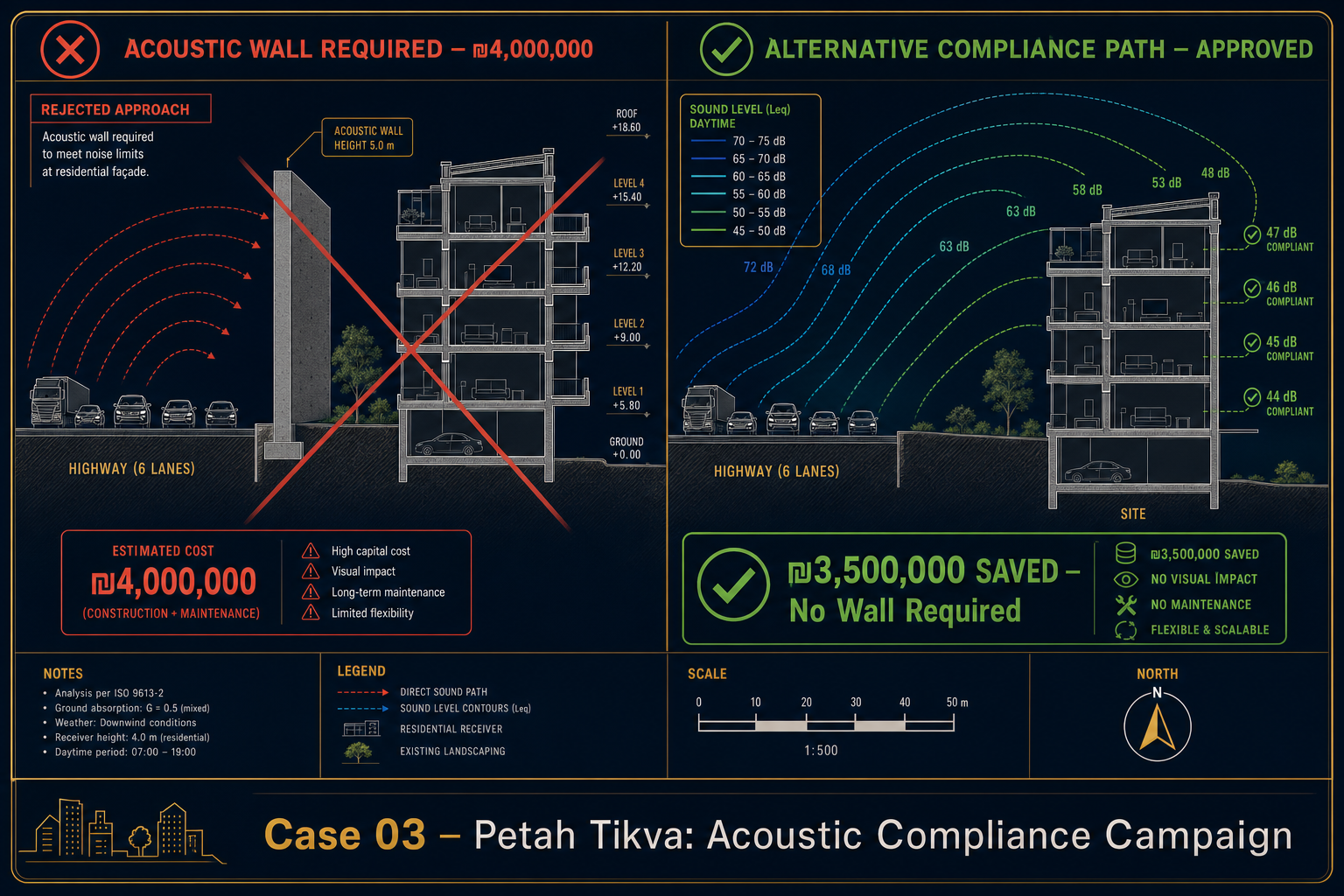
A planning directive required construction of an acoustic wall — estimated at ₪4 million and architecturally damaging to the site. Razore's acoustic team conducted precise sound level measurements, modeled actual noise exposure per ISO 9613, and identified an alternative compliance path that met regulatory requirements without the wall. The result: full regulatory approval, no barrier, and ₪3.5M in avoided construction costs.
"The question is never whether to conduct an environmental survey. The question is whether the survey is produced by someone who can defend it."
Who He Is
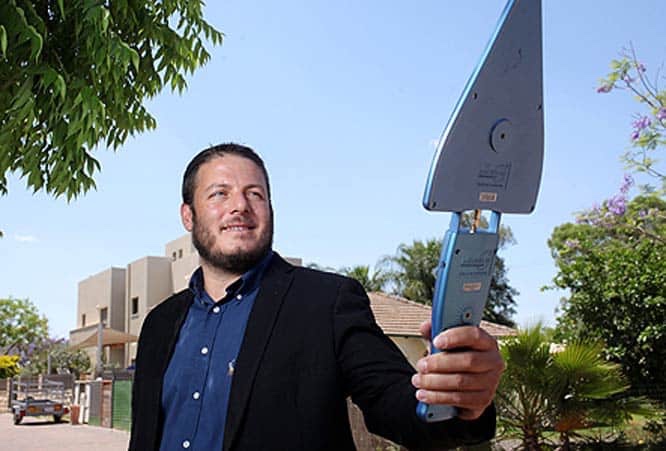
Dr. Raz Steinkritser completed his ASc in Electronics and Computers Engineering in 1997, then served in IAF electronics and communications — a technical foundation that shaped his understanding of electromagnetic field behavior at the systems level. A BSc in Industrial Engineering (Ariel University, 2009) and MBA (Ariel University, 2011) followed. He holds a PhD from the University of Haifa's Faculty of Natural Sciences and Environment, where his doctoral research addressed the effects of electromagnetic fields on biological systems. He presents at international conferences and contributes to the evolving science that underpins his regulatory work.
The expert witness designation is significant. Israeli courts accept qualified experts — not self-designated ones. Dr. Raz Steinkritser has been formally accepted by courts, local authorities, and the Ministry of Defense over two decades. Expert testimony operates under cross-examination from opposing technical experts. Every conclusion must be defensible under challenge. This standard shapes every survey his office produces — whether it ends up before a judge or in a permit file.
What He Does
Dr. Raz Steinkritser's practice covers the two principal categories of non-ionizing radiation relevant to Israeli construction and planning — each governed by distinct regulatory frameworks, each requiring calibrated field measurement under MoEP procedural guidelines.
ELF Radiation — The Electricity Grid
Extremely low frequency radiation from high-voltage lines, substations, and distribution panels is regulated in Israel at a residential and school threshold of 4 milligauss — 250 times stricter than the WHO general public ceiling. Developers building near electricity infrastructure need surveys that accurately characterize exposure under the stricter Israeli threshold and can withstand regulatory challenge on that basis.
RF Radiation — Cellular, Broadcast & Wireless
Radiofrequency radiation from cellular antennae, broadcast transmitters, and wireless infrastructure falls under MoEP regulations requiring that exposure in residential areas with prolonged occupancy not exceed 10% of the ICNIRP health threshold. Surveys must use calibrated, MoEP-approved equipment, follow the Radiation Supervisor's procedural guidelines, and produce documentation that planning committees accept on first submission.
Calibrated measurement of magnetic fields from electricity grid infrastructure. Regulatory-grade documentation built for planning committees.
Measurement of radiofrequency exposure from cellular antennae and broadcast sources. Compliance assessment against Israeli MoEP thresholds.
Formal expert testimony and written opinions accepted by Israeli courts, municipalities, and the Ministry of Defense in radiation disputes.
Pre-design consultation on antenna placement, shielding specifications, and site selection to prevent compliance problems before they're locked into drawings.
Direct engagement with planning committees, IEC, and MoEP on radiation requirements — including challenging incorrect or excessive demands.
PhD-level research on EMF effects on biological systems — regulatory positions informed by current peer-reviewed science, not decade-old standards.
Part of a Larger System
Dr. Raz Steinkritser is a senior specialist within Razore Engineering — over 150 professionals across six Israeli offices, conducting more than 1,000 surveys annually across the full environmental engineering spectrum: radiation, acoustics, green building, energy and thermal performance, hydrology, geotechnical engineering, soil contamination, air quality, and microclimate modeling.
The structural advantage for developers is coordination. When a radiation survey identifies an issue with a proposed building envelope, the acoustic engineer, green building consultant, and energy modeler are already on the same project file. One point of contact. No coordination lag between separately contracted consultants. No gap in responsibility when an issue spans disciplines.
Full Credentials
Every DDG project — from Nova District in Beer Sheva to The Grove in the Sharon — is backed by Razore's full team of 150 in-house engineers. Green building certification, radiation surveys, acoustic compliance, hydrology, geotechnical review — all under one roof, one point of contact for the developer, no coordination gaps between disciplines.