Green Building Engineering Analysis

What Environmental Quality Standards Actually Cost Israeli Developers — And What They Return

Israel's IS 5281 has moved from premium differentiator to planning condition. Razore Engineering's analysis of 60+ certified projects reveals the real cost at each rating level — and the measurable return on every shekel spent.

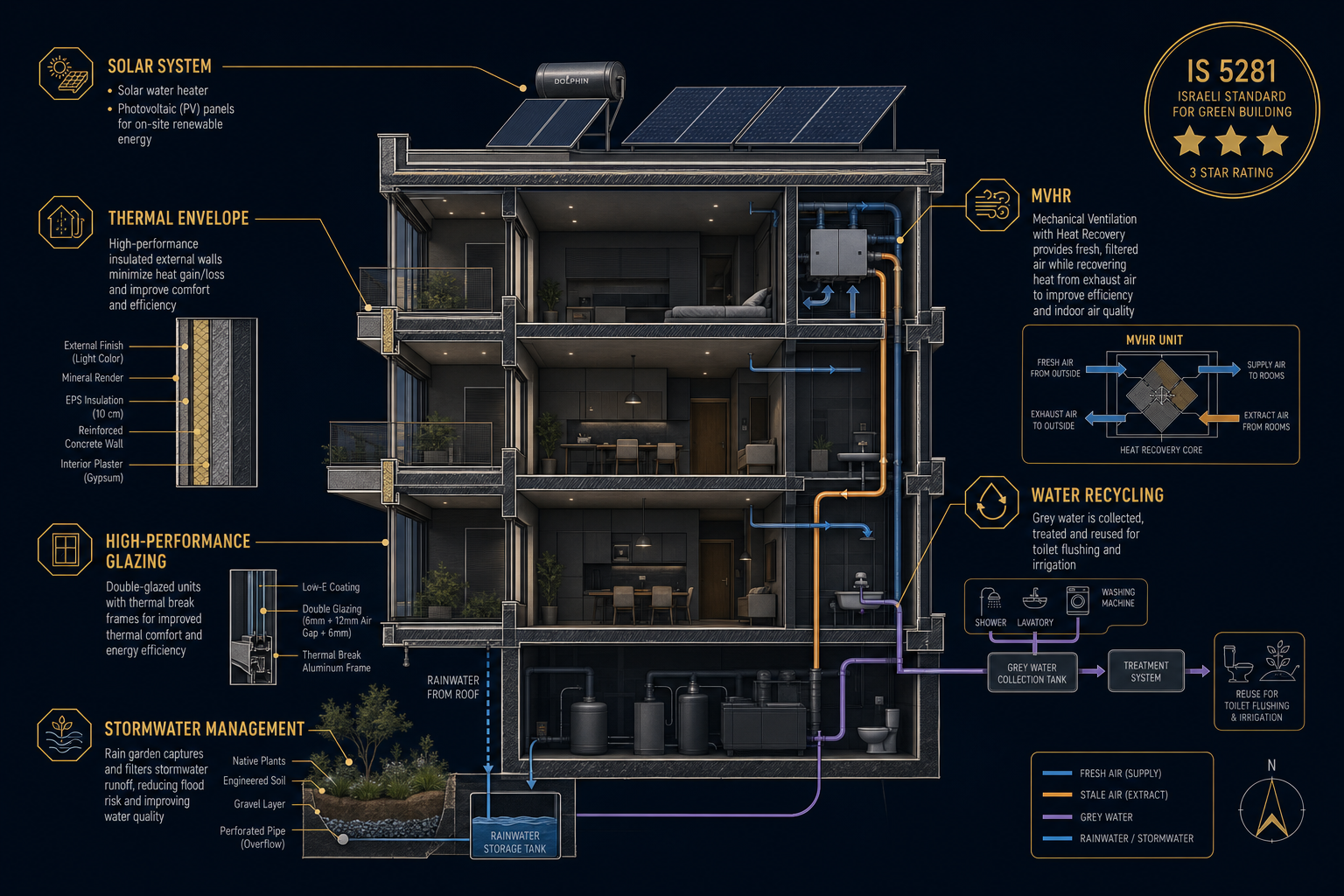
IS 5281 green building systems cross-section — solar, MVHR, thermal envelope, water recycling, stormwater management
The six engineering systems that determine IS 5281 rating — and the design decisions behind each one. Based on 60+ certified residential projects across Israel by Razore Engineering.

A developer in central Israel recently received a planning objection: the project's green certification was 1-star when the local planning committee expected 3-star compliance. The correction cost ₪2.3 million in redesign and delayed delivery by seven months. The original cost to build to 3-star from the outset: ₪680,000.

This is not an unusual story. Israel's IS 5281 standard has, in five years, shifted from an optional marketing differentiator to a planning condition in most major municipalities. Tel Aviv, Herzliya, and Ra'anana now routinely require 2-star minimum as a condition of building permits. Jerusalem's planning authority has moved toward 3-star requirements in certain zones. The market moved faster than many developers expected — and the penalty for underinvesting in environmental quality certification is no longer just reputational.

The three most expensive green building mistakes in Israel
  • Commissioning certification too late — after structural design is locked. Changes to thermal envelope, glazing specs, or ventilation systems at that stage cost 4–7× more than at design stage.
  • Treating IS 5281 as a checkbox rather than a performance system — choosing the cheapest measures to hit a target rating, rather than the ones with the best long-term energy return.
  • Under-rating intentionally to reduce cost, then facing planning committee conditions that require mid-build upgrades at penalty-rate contractor pricing.

The misalignment between developer assumptions about IS 5281 costs and the actual data is significant. Razore Engineering has supported certification on over 60 residential and mixed-use projects across Israel. The pattern is consistent: projects that integrate green building requirements from day one of schematic design pay a fraction of the cost that projects pay when certification is retrofitted into a near-complete design.

60+ IS 5281 projects certified with Razore Engineering
Cost multiplier for retrofit vs. design-stage certification
₪1.1M 25-year energy saving at 5-star (per 100m² unit)
8–12% Resale premium on 3-star+ units in Tel Aviv metro

IS 5281 Rating Levels: What Each One Actually Requires

Israel's Standard 5281 operates on a five-star points-based system across eight assessment categories: energy efficiency, water efficiency, indoor air quality, materials, waste management, land use, transportation, and site considerations. The critical distinction from LEED or BREEAM is that IS 5281 sets minimum performance thresholds in energy — a building cannot accumulate points elsewhere to compensate for energy underperformance. This makes the energy system design the foundational decision in any certification strategy.

Rating Min. Energy Requirement Key Systems Resale Premium
★★★★
1-Star
Basic compliance — Teken 1045 minimum Solar water heating; shading coefficient Minimal
★★★★★
2-Star
15% improvement over baseline Enhanced insulation (U ≤ 0.6); improved glazing; grey water recycling +2–4%
★★★★★
3-Star DDG min.
30% improvement; energy modelling required MVHR; improved thermal mass; materials tracking; commissioning +5–8%
★★★★
4-Star
50% improvement; near-zero operational energy Advanced HVAC; PV-ready; full acoustic compliance; third-party commissioning +8–12%
★★★★★
5-Star
Net-zero or net-positive; on-site generation mandatory Renewable systems; full life-cycle assessment; regenerative water +12–18%
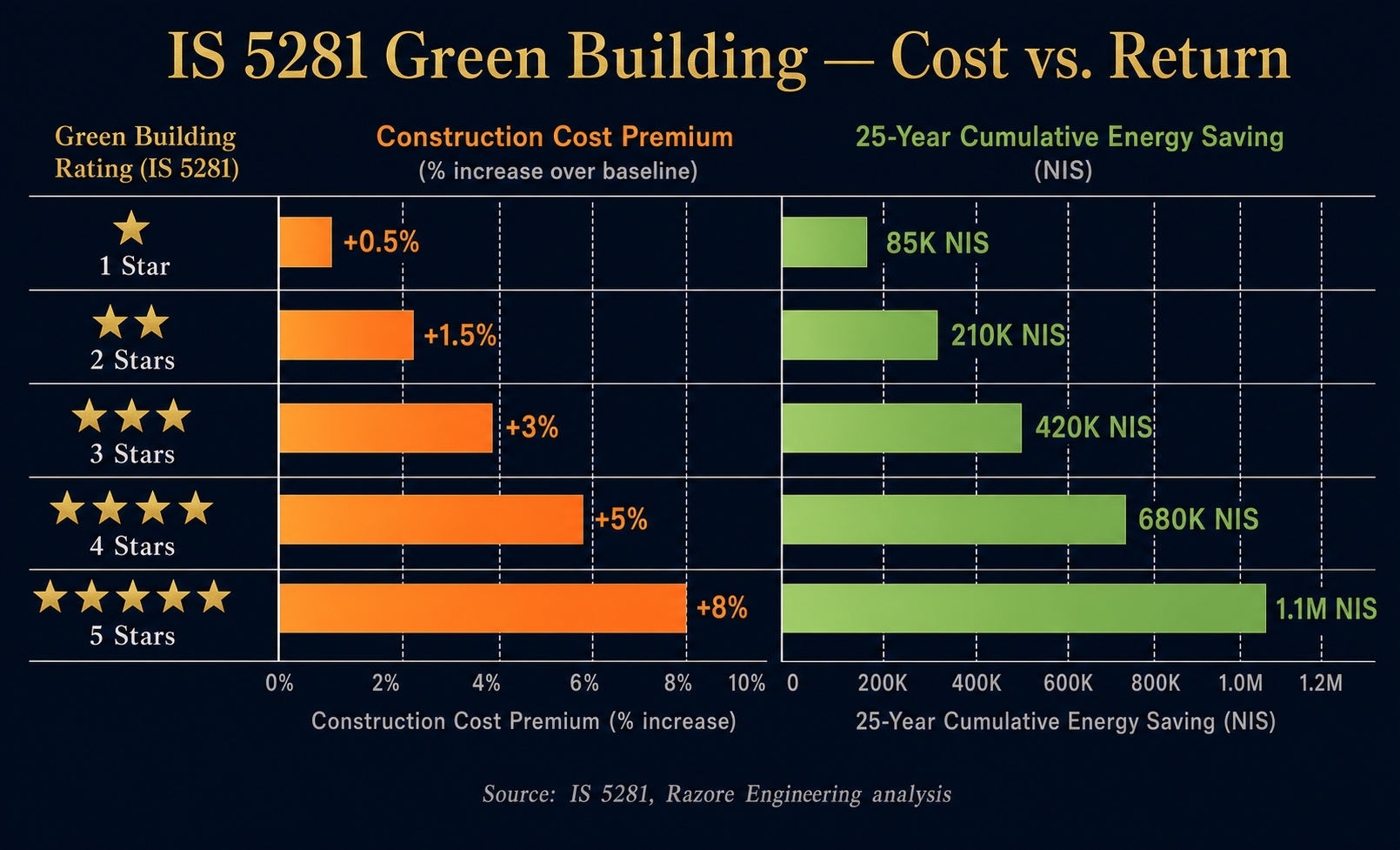
IS 5281 green building cost vs return — construction cost premium vs 25-year cumulative energy saving per rating level
Construction cost premium (% above standard build) vs. 25-year cumulative energy savings per 100m² unit, by IS 5281 rating level. At 3-star, break-even is typically reached within 9–11 years. Source: IS 5281, Razore Engineering analysis of 60+ certified projects.

The Six Systems That Determine Your Rating

IS 5281 is not a pass/fail system — it rewards the quality of integrated engineering decisions across the entire building. These six physical systems account for approximately 70% of a project's total certification score. Getting them right from schematic design stage is the single most cost-effective approach to maximizing rating and minimizing lifecycle operating costs.

Solar Energy System
Solar water heating is mandatory from 1-star. PV integration required from 4-star. Roof orientation and shading analysis at design stage determines feasibility and output.
Up to 18 pts
Thermal Envelope
External wall U-value, roof insulation, and thermal bridging at junctions are the largest single determinant of energy consumption in Israeli buildings due to the cooling-dominated climate.
Up to 22 pts
High-Performance Glazing
IS 5281 specifies shading coefficients by façade orientation. Low-e coatings, thermal break frames, and external shading devices are assessed independently. Incorrect glazing spec is the most common cause of rating downgrade.
Up to 16 pts
Mechanical Ventilation (MVHR)
Required from 3-star. Heat recovery ventilation improves indoor air quality while recovering 70–90% of exhaust heat. Duct routing and commissioning must be coordinated at structural stage — it cannot be retrofitted.
Up to 14 pts
Water Recycling
Grey water systems required from 2-star. Rainwater harvesting adds points at 3-star+. Israel's water scarcity context means municipal authorities increasingly require this regardless of certification level.
Up to 12 pts
Stormwater Management
Rain gardens, permeable paving, and detention basins address IS 5281 site criteria while reducing flood risk — a growing planning concern in Israeli urban areas following several major precipitation events.
Up to 8 pts
"

The best time to integrate IS 5281 engineering is at the brief stage — before any structural or services decisions have been made. At that point, reaching 3-star costs the developer almost nothing extra. The same result at the permit stage costs three to four times as much.

Three Projects — The Real Cost of Getting It Right (and Wrong)

The cases below are drawn from Razore Engineering's project portfolio. Each illustrates a different point in the cost-quality curve — and the financial consequences of the decisions made.

01
Case
Tel Aviv — Florentin
Residential · 42 units · 3-Star Certification
₪1.9M
saved vs.
retrofit cost
A boutique residential project in Florentin engaged Razore Engineering at schematic design stage. The 3-star certification strategy was built into the structural and MEP design from the outset — MVHR routing accommodated in ceiling heights, glazing specifications coordinated with the façade architect, grey water plumbed alongside primary drainage. The certification premium above a standard 1-star build: approximately ₪680,000 across 42 units — or ₪16,000 per unit. A comparable project in the same neighborhood that retrofitted 3-star requirements after structural completion spent ₪2.58M to achieve the same outcome.
02
Case
Herzliya Pituach — Mixed-Use
Mixed-Use · 28 units + commercial · 4-Star
+11%
resale premium
achieved
A mixed-use tower in Herzliya Pituach pursued 4-star IS 5281 certification as a deliberate market positioning decision. Razore Engineering designed the PV-ready infrastructure and MVHR system alongside the building engineer from concept stage. The additional construction cost above 2-star baseline: 4.8%, approximately ₪1.4M. The developer's sales analysis showed a consistent 10–12% premium on units marketed with 4-star certification and energy cost data. At the project level, the certification premium was recovered within 18 months of sales launch.
03
Case
Ra'anana — Suburban Residential
Residential · 60 units · Planning Condition
₪2.3M
penalty cost
incurred
A developer in Ra'anana submitted building permit applications with 1-star green certification — legally compliant nationally, but below the municipality's informal 2-star expectation. The planning committee issued a conditional approval requiring 2-star compliance before permit issue. Structural drawings were complete. The envelope upgrade and glazing specifications required structural revisions, adding seven months and ₪2.3M. The same developer's subsequent project, designed to 2-star from day one, added ₪580,000 in certification costs — and received planning approval in a single submission round.

What Buyers and DDG Members Should Know

Green building certification under IS 5281 is not a developer marketing exercise — it is a direct indicator of the long-term performance of a property. For buyers comparing projects, the rating level has measurable implications for utility costs, indoor environment quality, and eventual resale value.

At DDG, the green building engineering standard across our project portfolio is 3-star minimum — certified by Razore Engineering. The Square Tel Aviv, Nova District Beer Sheva, and White TLV each incorporate IS 5281 certification engineering from schematic design stage, not as a post-completion badge.

Energy costs A 3-star certified 100m² apartment in Tel Aviv typically saves ₪3,800–₪5,200 per year vs. an uncertified unit. Over a 25-year hold: ₪95,000–₪130,000 in cumulative savings at current energy pricing.
Indoor air quality MVHR systems required from 3-star produce filtered fresh air, controlled humidity, and significantly lower particulate levels than window-ventilated urban apartments.
Resale market positioning In the Tel Aviv metro, 3-star+ units command an 8–12% premium over uncertified equivalents of the same vintage. As certification requirements tighten, this premium is expected to widen.
Planning resilience Certified buildings are insulated against future regulatory shifts. Municipalities tightening minimum standards will not affect buildings that already exceed them.

For buyers evaluating projects in the current market, asking a developer directly: "What IS 5281 rating does this building carry, and when was the certification engineer engaged?" is a more revealing question than it might appear. A developer who engaged certification engineering at design stage will have a clear, confident answer. A developer who is still working out the answer has likely left it too late.

Engineering Partner
Razore Engineering — IS 5281 Certification from Design Stage
Razore Engineering provides integrated green building certification services across all IS 5281 rating levels — from schematic design review through to final commissioning and certificate issuance. Our team has supported 60+ certified residential and mixed-use projects across Israel. Every DDG project carries Razore Engineering's certification sign-off.

Related Insights